Application Scenarios
Momentum Photoelectron Spectroscopy: ARPES
With momentum space imaging technique, USM-SPE is able to image the whole upper hemispherical photoemission horizon of a sample. The acquired data is momentum image I(k, k) with different electron kinetic energies, which are stacked to from a 3D dataset I(E, k, k). The result can be obtained by slicing out at any direction . In addition, USM-SPE can select a small area in the sample space for μ-ARPES analysis for high-quality data.
Photoelectron spectroscopy (PES) is a powerful technique that detects the electronic structure of materials by measuring the energy of electrons emitted through the photoelectric effect. When extended to momentum space, it becomes Angle Resolved Photoelectron Spectroscopy (ARPES), which maps the electronic band structure by analyzing the energy and momentum of emitted electrons.
ARPES principle
1、photoelectric effect:Photons (ultraviolet/X-ray) excite electrons, and if their energy exceeds the work function, the electrons will escape from the material.
2、conservation of energy:The relationship between the kinetic energy (EK) of emitted electrons and their initial binding energy (EB) is:
EK=hν-ϕ-EB
Where h ν is the photon energy and ϕ is the work function of the material.
3、Momentum space:
· Parallel momentum(k∥):The kinetic energy (EK) of emitted electrons determines:
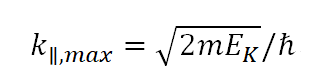
This allows for the mapping of momentum within the plane.
· Vertical momentum(k⊥):It is necessary to change the photon energy (e.g. using synchrotron radiation) and model the internal potential.
USM-P by using momentum space imaging technology, image the momentum space of the entire photoelectron emission hemisphere (2πk2) in the illuminated sample area,It is possible to obtain the electronic band structure diagram of the material and analyze its properties. As shown in Figure 1, after the photoelectrons are received by the detector, momentum spatial images of the kinetic energy of different electrons can be obtainedI(kx, ky)。Stacked to form a three-dimensional I (Ek, kx, ky)dataset.By using the CT section method, any direction can be cut out to obtain results. In addition, USM-P can select a smaller range in the sample space for micro ARPES analysis, providing high-quality data.
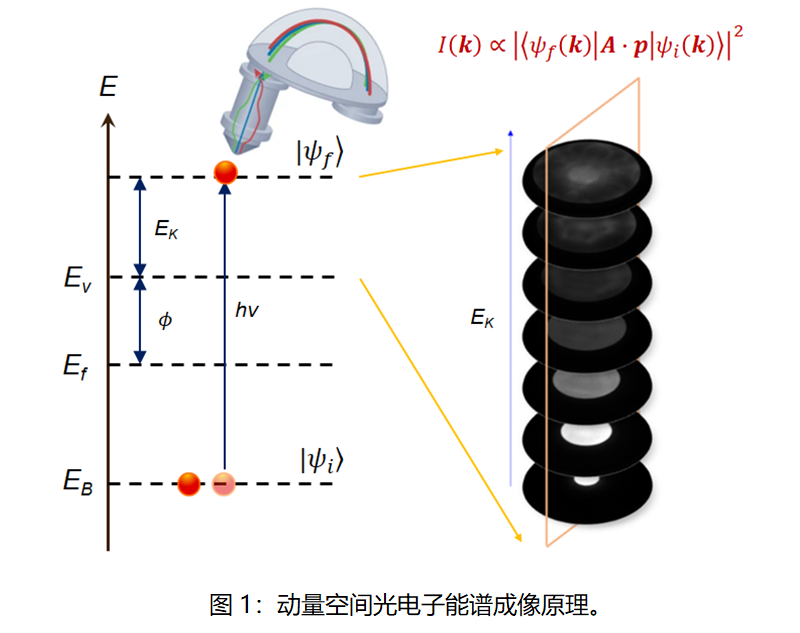
Figure 1: Principle of momentum space photoelectron spectroscopy imaging.
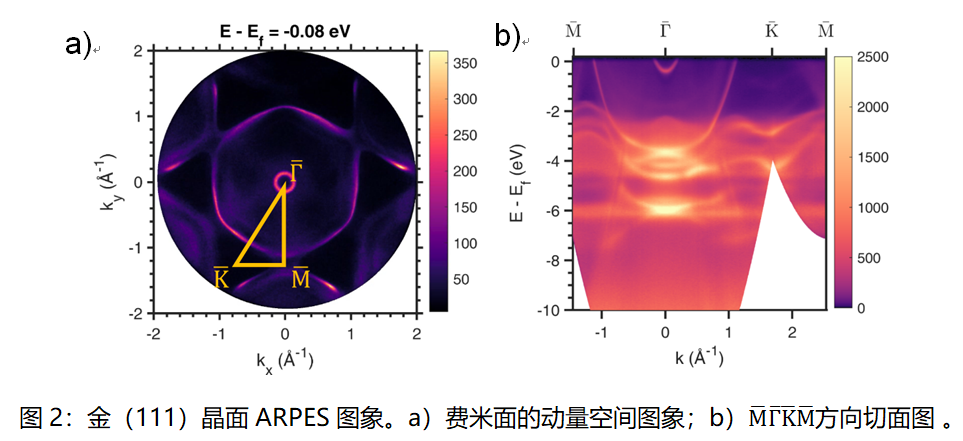
Figure 2: ARPES image of gold (111) crystal plane. a) Momentum space image of Fermi surface; b) MRKM directional sectional view.
Video Presentation